

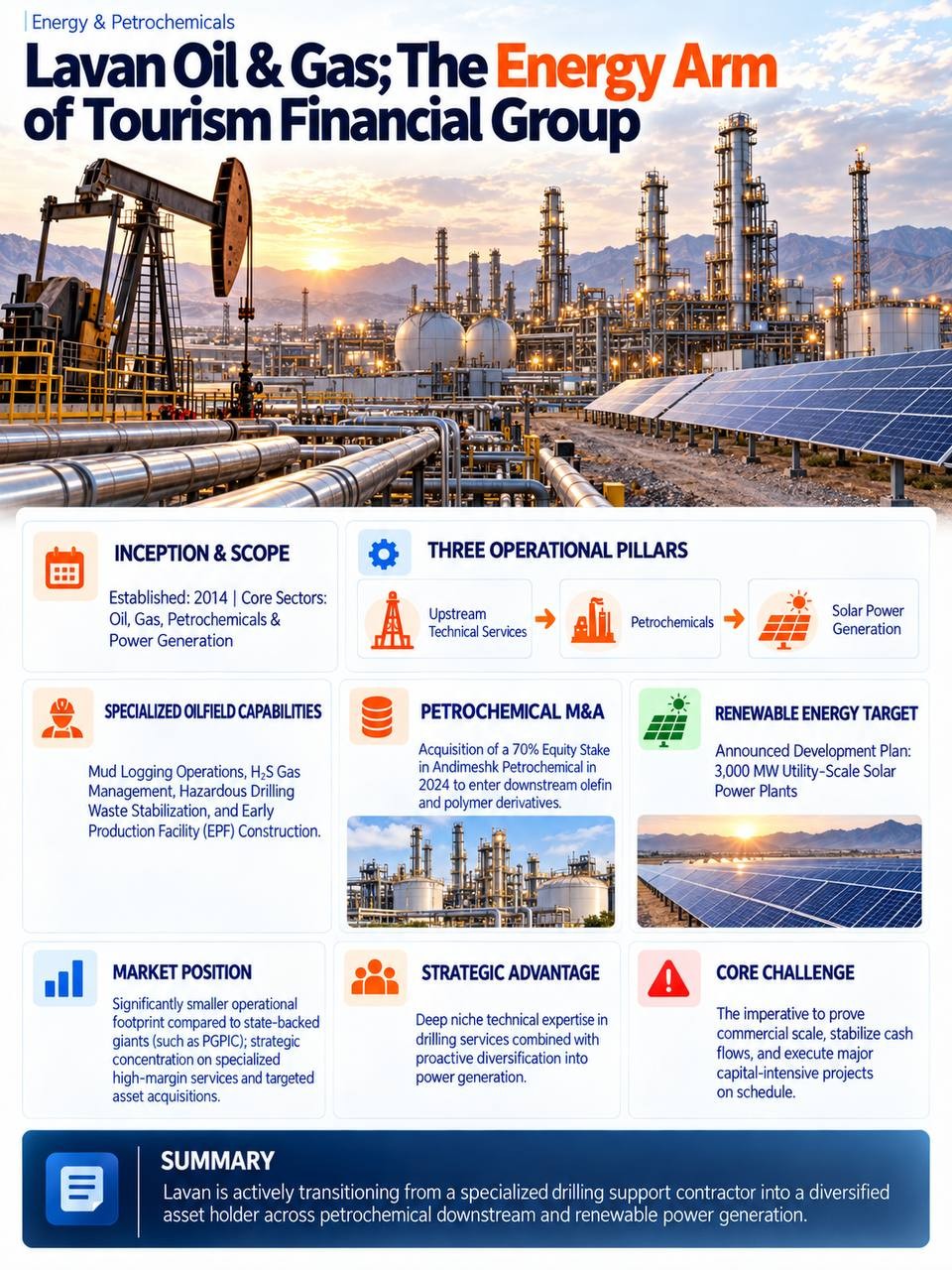
Operating as the primary energy and industrial development vehicle of Tourism Financial Group, Lavan Oil & Gas is executing an ambitious multi-sector diversification strategy, expanding beyond specialized upstream oilfield services into downstream petrochemical manufacturing and utility-scale solar energy generation to secure predictable, long-term operational cash flows.
A comprehensive analysis of Lavan Oil & Gas highlights the company’s ongoing transition from a specialized oilfield services contractor into a diversified, multi-asset industrial player aligned with regional energy transition dynamics:
Foundational Upstream Capabilities and Specialized Technical NichesEstablished in 2014, Lavan Oil & Gas built its operational foundation by focusing on high-barrier technical services within the upstream sector. Rather than engaging in commoditized drilling segments, the company targeted high-margin technical niches, including advanced mud logging operations, toxic hydrogen sulfide () gas containment, and hazardous drilling waste stabilization and environmental management. Furthermore, Lavan developed specialized engineering capabilities in the design and construction of Early Production Facilities (EPF), enabling upstream operators to accelerate crude commercialization ahead of full-field development. These core technical competencies established the company as a reputable engineering partner across complex, sour-gas, and deep drilling environments.
The Tri-Pillar Model and Energy Transition Alignment
To overcome the revenue volatility and structural payment cycles common to conventional upstream service contracts, Lavan has restructured its corporate portfolio around three core operational pillars: Upstream Technical Services, Downstream Petrochemicals, and Solar Power Generation. This tri-pillar operational framework enables the company to transition from a pure service provider into a capital-asset holder. By combining industrial processing assets with grid-connected renewable power plants, Lavan creates predictable revenue streams that insulate its broader balance sheet from crude oil price swings and cyclical drilling budgets.
Downstream Value Addition via Andimeshk Petrochemical M&A
Marking a decisive step into downstream manufacturing, Lavan acquired a 70% controlling equity stake in Andimeshk Petrochemical in 2024. This strategic transaction grants the company direct entry into the production of olefin derivatives and polymer products, capturing value further down the hydrocarbon processing chain. By integrating downstream polymer synthesis into its portfolio, Lavan shields its corporate revenues from upstream raw commodity shocks while reinforcing Tourism Financial Group’s broader commitment to domestic industrial value addition.
Decarbonization and Grid Support: The 3,000 MW Solar Program
In response to national electricity deficits and shifting environmental mandates, Lavan has undertaken an expansive 3,000 MW utility-scale solar power development program. The company initiated operational rollout with commercial solar installations in Kashmar, creating an immediate physical generation footprint. Expanding into utility-scale solar generation allows the company to capitalize on specialized green electricity trading mechanisms and guaranteed corporate offtake arrangements, generating recurring, non-oil revenues over multi-decade operational horizons.
Institutional Underwriting and Tourism Bank’s Capital Allocation
Detailing the strategic and financial rationale behind this expansion, Mohammad Bigdeli, CEO of Tourism Bank, highlighted the deliberate nature of this asset allocation: “Backing renewable energy projects and downstream petrochemical assets through Lavan creates stable, recurring revenue streams while reducing structural reliance on single-sector revenues across the group’s asset portfolio.” Through structured corporate lending and debt underwriting, Tourism Bank provides the financial architecture necessary to advance these capital-intensive industrial developments.
Market Positioning, Execution Risks, and Strategic Outlook
While maintaining a significantly smaller operational footprint compared to state-backed petrochemical giants such as PGPIC, Lavan’s competitive advantage lies in its deep niche technical expertise and operational agility. Moving forward, the firm’s primary challenge centers on proving commercial scale across its expanded assets, maintaining project execution timelines, and stabilizing long-term cash flows amidst complex macroeconomic conditions. Delivering on its petrochemical commissioning and solar milestones will solidify Lavan’s position as a modern, diversified energy champion.
Lavan Oil and Gas, Solar Energy, Andimeshk Petrochemical, Tourism Bank, Mohammad Bigdeli, Energy Transition, Tourism Financial Group
